 Rug
Hooking DescriptionsRug
Hooking Descriptions
Rug
Hooking DescriptionsRug
Hooking Descriptions
 Hooks
~ There are different size hooks (points) depending on your preference
and hooking need (primitive versus traditional fine rugs). Ask the pattern
supplier which type is best for your project. Hooks are generally around
$4.50 - $8.00.
Hooks
~ There are different size hooks (points) depending on your preference
and hooking need (primitive versus traditional fine rugs). Ask the pattern
supplier which type is best for your project. Hooks are generally around
$4.50 - $8.00.
 Frames~ (which includes lap frames, floor frames and hoops )
Frames are either wooden or metal such as the Puritan Frame. For large
rugs, many people prefer a larger floor frame. Tacks are used to attach
the backing material to wooden frames and the Puritan Frame has carding strips
with gripper like teeth that hold the backing material firmly in place. A
hoop frame, used for needlepoint, etc, is smaller and good for small projects,
especially to avoid a large expense until you are sure you like to hook.
You can buy these at most craft stores. Frames are priced anywhere from
$13.00 up to $200.00.
Frames~ (which includes lap frames, floor frames and hoops )
Frames are either wooden or metal such as the Puritan Frame. For large
rugs, many people prefer a larger floor frame. Tacks are used to attach
the backing material to wooden frames and the Puritan Frame has carding strips
with gripper like teeth that hold the backing material firmly in place. A
hoop frame, used for needlepoint, etc, is smaller and good for small projects,
especially to avoid a large expense until you are sure you like to hook.
You can buy these at most craft stores. Frames are priced anywhere from
$13.00 up to $200.00.
 Scissors
~ The scissors pictured are a light weight, bent handle and sharp pointed rug
scissor. Made to specifications in Solingen, Germany of the best grade cutlery steel.
These specialty scissors are available enabling one to trim the wool material flush to the loop
piles. The scissors pictured cost around $25.00.
Scissors
~ The scissors pictured are a light weight, bent handle and sharp pointed rug
scissor. Made to specifications in Solingen, Germany of the best grade cutlery steel.
These specialty scissors are available enabling one to trim the wool material flush to the loop
piles. The scissors pictured cost around $25.00.
Cutter & Blades
( to cut the wool material into strips). There are different types of cutting
machines, some with suction cups to keep it stable, others with a clamp on
device for a table. There are also different size blades to cut the wool
into different size strips appropriate for your rug. Cutters can cost from
$120.00 upwards with blades around $13.00 and up.
Rug Pattern ~This
pattern is drawn on Monk's Cloth although patterns are available on Backing material of
choice. Pattern costs range depending on size and intricacy. The
biggest cost is not the pattern itself, but the wool material.
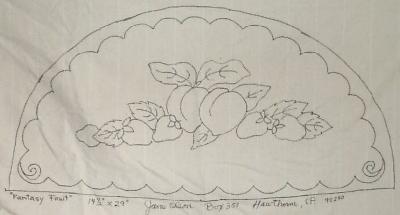
Photograph courtesy of Jane Olson Rug Studio - "Fantasy Fruit"
 Wool Material
~ Wool material can be purchased by the yard or piece, or in
swatches as pictured here. Swatches are usually 6 pieces of material of
gradient shades of one color. Experience rug hookers also dye their own material
with dyes one can purchase through rug hooking suppliers.
Wool Material
~ Wool material can be purchased by the yard or piece, or in
swatches as pictured here. Swatches are usually 6 pieces of material of
gradient shades of one color. Experience rug hookers also dye their own material
with dyes one can purchase through rug hooking suppliers.
Many patterns are available in kit formats which include the pattern, material and instructions. Some suppliers will also cut the wool material for newcomers for no charge or a small fee.
For newcomers to this craft, there are instruction books and video tapes available, but the best way to get started is with hands-on instruction. There are many wonderful Rug Hooking Guilds, Teachers, Workshops and Hooking Groups available to help you get started. Rug Hooking, like any craft or art form, requires perfection of techniques to get the desired results, and as with any passion, it is fun to learn!
 PUNCH NEEDLE HOOKING AND SPEED NEEDLE HOOKING
Needles -
May include the Hand or Speed Needle (pictures),
Adjustable Needle or Oxford Needle (not-pictrued)

 Graphics courtesy of Rumpelstilskin's:
www.rumpelstiltskinsrugcrafting
Graphics courtesy of Rumpelstilskin's:
www.rumpelstiltskinsrugcrafting
Frame
Cutter & Blades
Rug Pattern
Wool Yarn Material
As with Traditional rug hooking, there are some wonderful resources to get you started, or to provide you with the pattern and equipment needed to get started.
LATCH HOOKED STYLE RUGS